
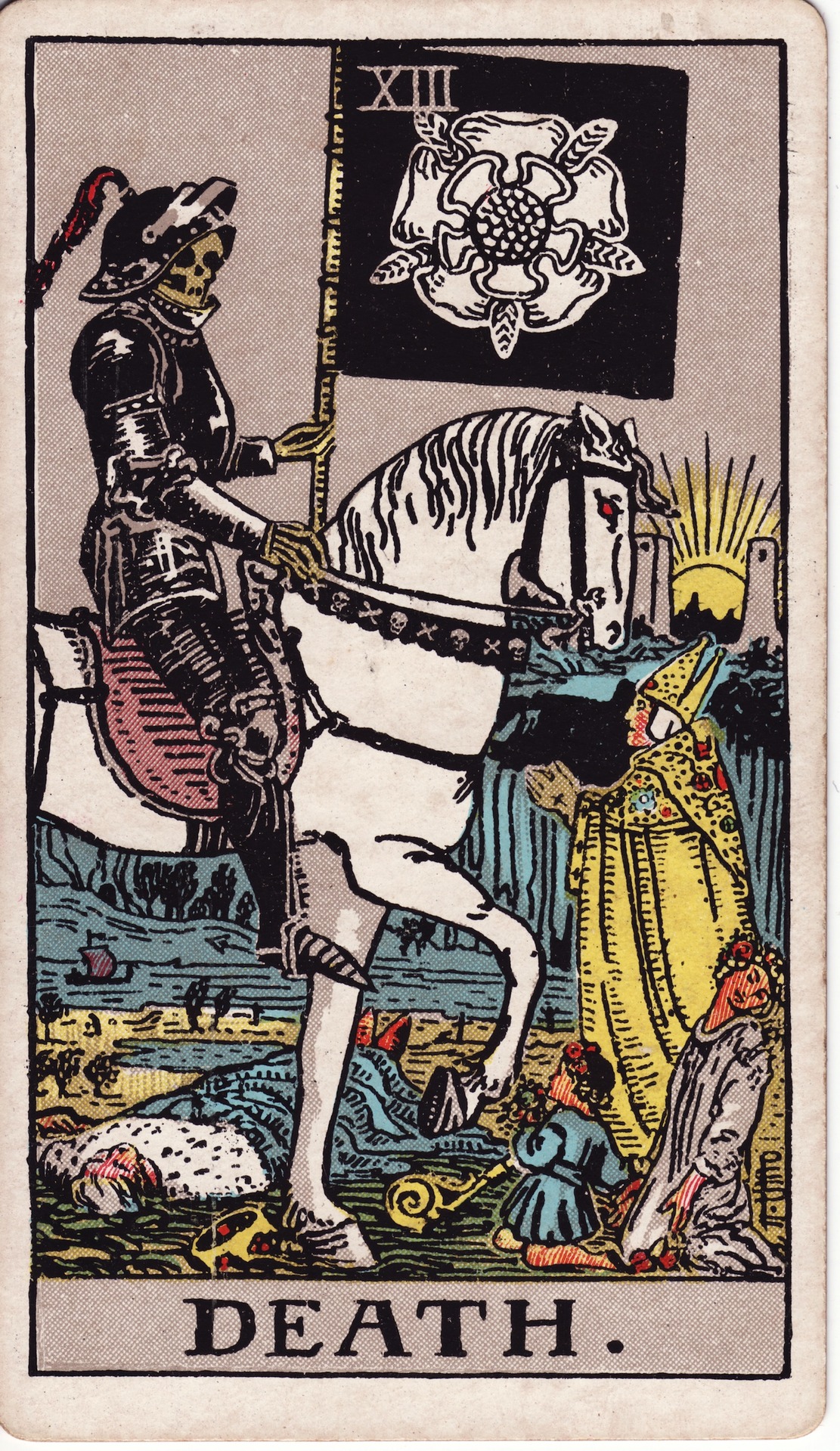
XIII · Major Arcana
The Death Card Found You. Here's What It Actually Means.
If this is your first pull, take a breath. Death is not what the movies told you. Here's what this card is actually saying about your life right now.
Death Tarot Card — Quick Meaning
Upright
Transformation. The end of a chapter. Necessary release. Death is the card of completed cycles — not literal endings, but the structural close of a phase whose work is done.
Reversed
Resistance to change. A transformation paused mid-step. Reversed, Death is the version where you've felt the ending coming but haven't yet let it complete.
Death keeps finding you. See what it's actually telling you.
See What Death Means for YouThis card doesn't mean what you think. Your face will show you.
Join 250+ people who've seen themselves in the cards.
Death Tarot Card Meaning — Full Interpretation
Death Upright Meaning
The first time most people pull the Death card, they close the laptop. The skull. The black robe. The horse. Centuries of bad movies and worse paperbacks have done a thorough job of teaching everyone the wrong thing about this card. So before anything else: Death in tarot is not about dying. Not for you, not for anyone you love. It is one of the most badly misunderstood cards in the deck and one of the most precise.
Almost everything you've been told about this card is wrong. Death in tarot is the card for naming the specific moment when a chapter of your life is actually over — not metaphorically over, not "you should think about closing this soon" over, but *over*. The work is done. The lesson has been learned. Now you are being asked to let the thing end.
The traditional image is a skeleton on horseback, riding past a king who is unbowed. The point of the image is the king. Death does not care about your titles, your sunk cost, or your stories about how this part of your life was supposed to go. Death only cares whether the cycle is complete. If it is, the chapter closes. The kingdom continues; the king does not.
Death usually shows up at exactly the moment you've started suspecting it's time. You've felt the relationship complete itself in private. You've outgrown the version of yourself you kept performing at work. The career you built no longer fits the person you've become. Death isn't telling you these things. It is *confirming* them — and asking whether you are willing to formally close the door.
What survives Death is what was never going to die. The friendships that last past the version of you you're leaving. The values you carry into the next chapter. The skills that translate. Death is not asking you to lose those. It is asking you to stop carrying the dead weight that was never coming with you anyway.
If you have pulled this card and felt a strange relief, that is the card working as intended. Death almost always brings the same feeling: *finally*.
Death Reversed Meaning
Reversed, Death is the transformation that has been paused mid-step. You sense the ending. You've made peace with it intellectually. But there is one last thread you keep refusing to cut — usually because you're afraid of what becomes possible without it.
This reversal is one of the gentler versions of the card. It is not telling you the ending isn't real. It is telling you the ending is real *and* you are choosing the pace. That choice has costs: the next chapter can't begin while the previous one is still partially open, and the things that were supposed to be released are calcifying instead of clearing.
The reversed Death asks one question. What is the one thread you haven't cut yet? Name it. The card is patient. The thread is still there.
Death Love & Relationships
In love, Death is the end of a version of the relationship — not necessarily the relationship itself. The partnership you had at year three may be over; the one waiting at year four may be different and more honest. For partnerships that *are* ending, Death is the clarity that the ending has already happened internally, and the only remaining work is acknowledgment.
For singles, Death frequently marks the end of a pattern: the kind of partner you keep choosing, the role you keep performing, the story about love you've outgrown. What dies in that case is the version of you that needed that pattern.
Death Career & Work
In work, Death is the close of a career chapter — the job you finished growing in, the role that asked for a person you no longer are, the identity built around a craft you've quietly evolved past. Death is rarely the announcement of a firing or a quit; it's the diagnosis that the chapter is over and you are still inside it.
Reversed, the career Death is the ending you've negotiated down to a half-step: cutting your hours but not leaving, mentally checking out but staying on payroll. The card is patient about this. It also notices.
Why Do You Keep Getting Death?
Why do you keep getting Death?
Because the chapter you're being asked to close is large, and the deck is being patient with you. Death rarely repeats for people who got the message the first time. It repeats for people who heard it, felt it, half-acted on it, and are now waiting for the card to either let them off the hook or insist.
It's insisting.
Repeat Deaths usually accompany a specific feeling: *I know what's over. I just don't know what comes next.* That fear of the unknown is the only thing keeping the chapter open. Death will not tell you what comes next. It is not that kind of card. Its job is the ending. The next card you pull — almost always — is the one that begins to describe what's possible after.
If Death keeps finding you, it's not foreshadowing a loss. It's reflecting the loss you have already had, and waiting for you to call it by its name out loud.
A reading personalized to you — your face on the figure, not someone else's — can show you exactly which chapter Death is naming. That specificity is often the only thing missing between feeling the ending and finally completing it.
Death Reading, Personalized to You
Death keeps finding you. See what it's actually telling you.
Most tarot apps give you the same Death meaning everyone else gets. Selfarcana generates a reading based on your face.
Stop wondering why you keep pulling Death. See what it means for your face.
This card doesn't mean what you think. Your face will show you.
Upload a photo. Get your reading. Takes 60 seconds.
Frequently Asked Questions — Death
+What does Death mean in tarot?
Death means transformation — the close of a chapter whose work is complete. It is almost never a literal warning. It is the card that names an ending that has already happened internally and is asking to be acknowledged externally.
+Is Death a good or bad card?
Death is not bad. It can be uncomfortable, but it is one of the most precise and ultimately freeing cards in the deck. What dies is what was already finished. What survives is what was always going to.
+What does Death mean reversed?
Reversed, Death is a transformation that has paused mid-step. The ending is real; the choice to complete it is being delayed. The card asks which last thread you haven't yet cut.
+Why do I keep getting Death?
Death repeats when a large chapter is closing and you've heard the message but haven't yet acted on it. The card is being patient — and also insisting. A reading personalized to you can show you exactly what Death is reflecting about your life right now.
+What does Death mean for love?
In love, Death usually marks the end of a version of a relationship — not necessarily the relationship itself. For partnerships that are truly ending, it is the clarity that the ending happened long before the conversation about it will.